
Understanding the Basics of Fiber Optic Light Transmission
Fiber optic lighting works by transmitting light through optical fibers, which are flexible strands made from glass or plastic. The core principle behind this transmission is total internal reflection (TIR). Light enters the fiber at a specific angle, known as the acceptance angle, and reflects within the core without escaping, allowing it to travel long distances. Surrounding the core is cladding with a lower refractive index, ensuring light remains confined.
This mechanism is highly efficient for transmitting light to remote locations, enabling applications ranging from ambient lighting to precise spot illumination. The light sources used in these systems, called illuminators, are commonly LEDs, halogen lamps, or xenon lights, designed to maximize the light coupled into the fibers.
Types of Fiber Optic Lighting Systems
There are two main types of fiber optic lighting systems:
- End-Emitting Fiber: This type focuses light transmission to the fiber’s end, producing a spotlight effect. It’s commonly used for display lighting in museums or retail environments.
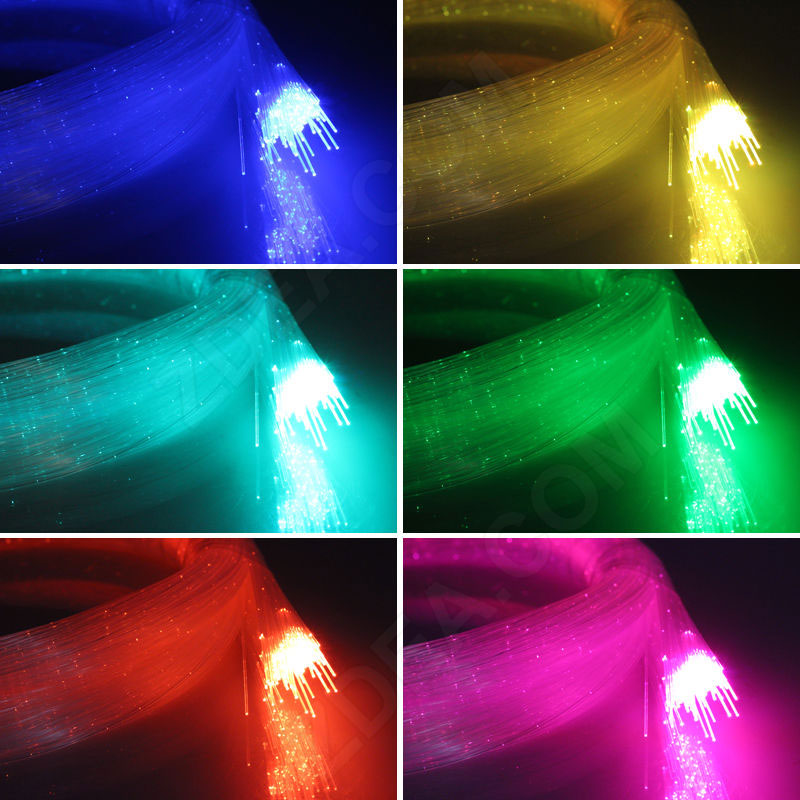
- Side-Emitting Fiber: These fibers emit light along their length, resembling neon tubes. They are often employed in decorative lighting, such as creating starry ceilings or accentuating architectural features.

Each type is optimized for specific purposes, with variations in fiber diameter and material (glass or plastic) determining their efficiency and suitability.
Advantages of Fiber Optic Lighting
Fiber optic lighting systems offer numerous benefits that set them apart from traditional lighting solutions:
- Heat-Free Illumination: As the light source is remote, fibers transmit light without heat, making them ideal for illuminating delicate objects in museums or galleries.
- Electrical Safety: Since fibers do not carry electrical current, they are safe for underwater or hazardous environments like swimming pools and industrial sites.
- Flexibility: Optical fibers can be bent and shaped to fit various designs, allowing for creative lighting solutions.
- Energy Efficiency: With minimal energy wasted as heat, these systems often use energy-efficient light sources like LEDs.
Applications of Fiber Optic Lighting
Thanks to its versatility, fiber optic lighting is used in diverse fields:
- Architectural Lighting: Enhancing aesthetics through accent lighting, starry ceilings, and cove designs.
- Outdoor and Landscape Lighting: Safe for illuminating pools, fountains, and gardens due to its non-conductive nature.
- Museum and Exhibition Displays: Protecting sensitive artifacts by eliminating heat and UV radiation.
- Commercial and Retail Spaces: Highlighting products and creating dynamic signage with customizable colors.
- Medical and Industrial Uses: Providing precise illumination in surgeries or inspecting hard-to-reach areas in machinery.
Fiber optic lighting’s adaptability ensures it meets aesthetic, functional, and safety requirements in a variety of settings.

About the Author: PMMA-KEN
With 12 years of experience in PMMA fiber projects, I have developed a strong expertise in production, sales, product integration, and project execution for plastic optical fiber cables. My in-depth knowledge spans across various stages of the process, from manufacturing to implementation, allowing me to offer comprehensive solutions tailored to meet the unique needs of each project.